
How Is Your Due Date Calculated? Naegele's Rule Explained
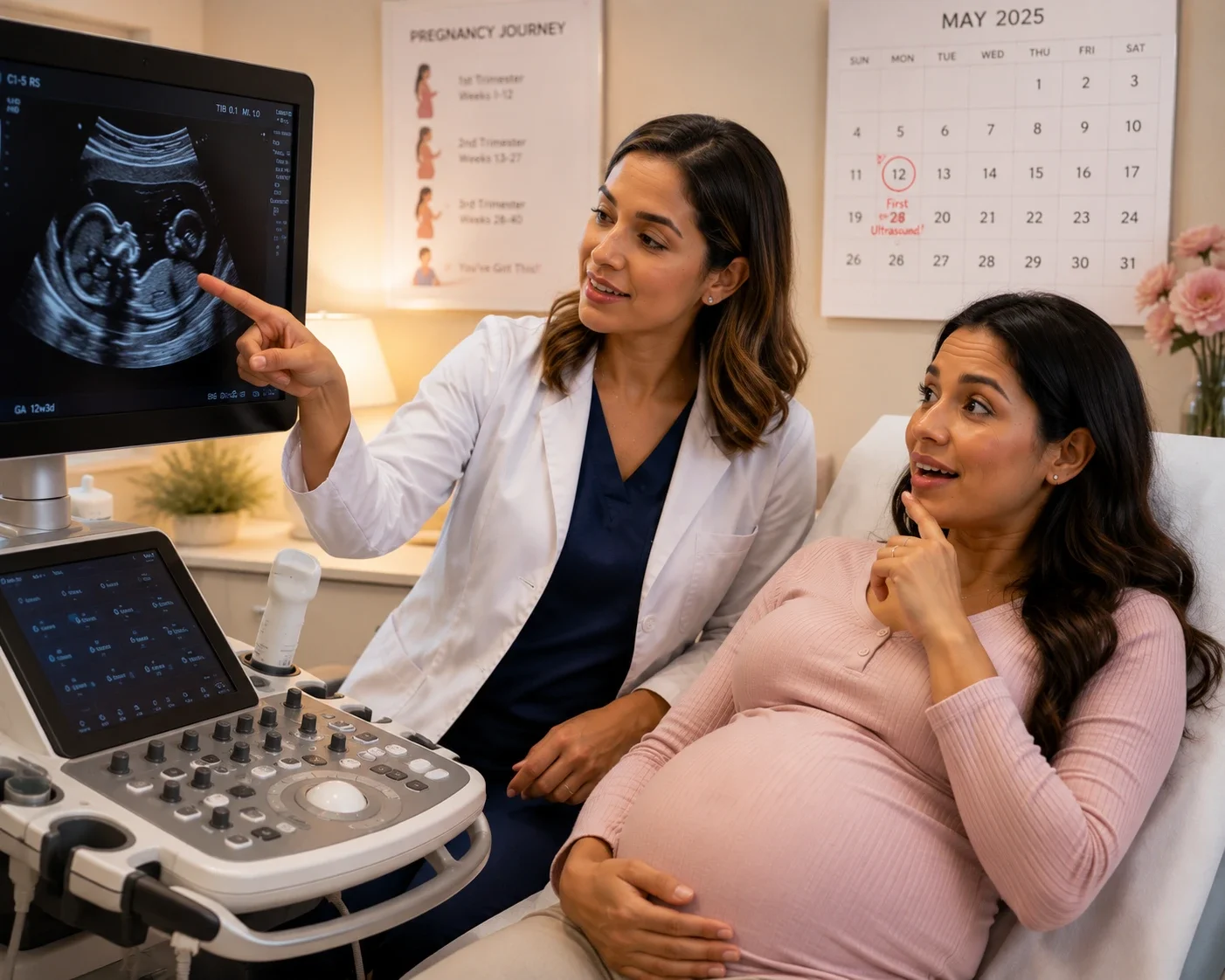
Have you ever gone to your first prenatal appointment and been told you're six weeks pregnant, when you're absolutely certain you only conceived four weeks ago?
You're not wrong. And neither is your doctor. This is one of the most common points of confusion in early pregnancy, and once you understand how due dates are actually calculated, it makes complete sense.
Dr. Monique breaks down how pregnancy dating works and why your due date is more of a starting point than a finish line:
Why Does Pregnancy Start From Your Last Period?
Here's the thing that trips most people up: pregnancy is dated from the first day of your last menstrual period (LMP), not from the day you actually conceived.
This means that for the first two weeks of your "pregnancy," you technically weren't pregnant yet. Ovulation and conception happen around day 14 of a typical 28-day cycle. So when your provider tells you that you're six weeks pregnant, what they mean is that it has been six weeks since the first day of your last period, even though conception likely happened about two weeks after that.
This system goes back centuries and became standardized through a method called Naegele's Rule,named after the 19th-century German obstetrician Franz Karl Naegele, who formalized it. It's the foundation that the entire modern pregnancy dating system is built on.
What Is Naegele's Rule?
Naegele's Rule is a simple formula for calculating your estimated due date (EDD):
Take the first day of your last menstrual period → Add 7 days → Subtract 3 months → Add 1 year
That gives you your estimated due date. Remember, a due date is an estimate of when you will deliver. It is not the exact day to expect your baby. It is normal for babies to deliver up to 3 weeks before and 2 weeks after the due date.
It is important to know Naegele’s rule is based on a 28 day cycle. If your cycle is longer, 30-35 days, your due date will be later. You will need to add 2 to 7 days to the due date calculated using Naegele’s rule.
You can also think of it this way: add 280 days (40 weeks) to the first day of your last period.
These days, you don't need to do the math by hand. Pregnancy due date calculators are widely available. You can plug in the date and get an instant estimate. But understanding the formula helps you understand why the number your provider gives you might feel surprising.
A Real-Life Example
Let's make this concrete.
Say your last period started on June 1st. You go to the doctor on July 15th. Your provider tells you that you're approximately six weeks pregnant.
Your reaction: That can't be right, I only conceived about four weeks ago.
And you're correct. Conception likely happened around June 14th or 15th, about two weeks after your period started. But because pregnancy is counted from June 1st, you're six weeks along by the time of your July 15th appointment, even though the actual embryo is only about four weeks old.
This is why there's always that two-week difference between how far along you feel and what your provider tells you. It's not an error, it's just how the calendar of pregnancy works.
How Does the First Trimester Ultrasound Factor In?
Naegele's Rule is accurate if you have very regular cycles. The first trimester ultrasound is a routine part of early prenatal care to confirm the due date or give you a due date if your cycles are irregular or you are unsure of your LMP.
During this ultrasound, your provider measures your baby's crown-rump length (CRL), the distance from the top of the head to the bottom of the spine. In the first trimester (up to about 13 weeks and 6 days), this measurement is accurate to within 5 to 7 days and is the gold standard for confirming gestational age.
How Ultrasound Confirms or Adjusts Your Due Date
If the ultrasound measurement differs from your LMP-based due date by more than 5 to 7 days (depending on how early the scan is performed), your provider may adjust your due date to match what the ultrasound shows. This is completely normal and not a cause for concern. It simply means the ultrasound gave a more precise picture than the calendar calculation could.
According to ACOG, a pregnancy without an ultrasound that confirms or adjusts the due date before 22 weeks of gestation is considered "suboptimally dated." This is one of many reasons why early prenatal care and first trimester ultrasound access matter so much.
What If You Don't Remember Your Last Period?
Not everyone tracks their cycle closely, and that's okay. If you're unsure of your LMP, ultrasound becomes even more valuable as the primary dating method. An early first trimester ultrasound can establish gestational age with good accuracy even without LMP data.
If you don't have a first trimester scan, second trimester ultrasounds (between 14 and 22 weeks) can still provide a reasonable estimate, though they carry slightly more variability, typically accurate to within 7 to 10 days.
The earlier an ultrasound is performed, the more accurate the dating. That's another reason why starting prenatal care early in the first trimester makes such a meaningful difference.
Is Pregnancy Really Nine Months?
Not exactly, and this is another common source of confusion.
Pregnancy is 40 weeks long, measured from the first day of the last menstrual period. From the date of actual conception, it's closer to 38 weeks. Either way, 40 weeks doesn't divide evenly into 9 calendar months, it's actually closer to 9 months and 1 week, or about 10 lunar months.
The "nine months" framing has stuck around culturally, but when your provider talks about gestational age, they're working in weeks, and that's the number that matters for scheduling appointments, interpreting tests, and planning your delivery.
Can Your Due Date Change?
Yes, and this is more common than most people expect.
Your due date can be revised if:
Your first trimester ultrasound doesn't match your LMP-based date by more than a few days
Your periods are irregular, making LMP dating less reliable
You conceived through assisted reproductive technology (ART) like IVF, in which case the embryo transfer date is used to assign the EDD with high precision
Your first ultrasound is performed in the second trimester, where variability is greater
A change in due date is not alarming, it's simply a refinement of the estimate as more information becomes available. Your care team will communicate any changes and explain what prompted them.
Your Due Date Is an Estimate — Not a Deadline
Here's something important to hold onto: only about 5% of babies are born on their exact due date. Most births happen within two weeks before or after. Your due date is the midpoint of a normal delivery window. It gives you and your provider a target for planning and monitoring, but it is not a precise expiration date.
What matters more than the date itself is the quality of care you receive throughout the weeks leading up to it: regular monitoring, informed conversations with your provider, and a team that takes the time to make sure you understand what's happening at every stage.
Our group prenatal visits at Enrich Health are designed around exactly that kind of care. You'll have ample time with your provider, education delivered in a supportive community setting, and space to ask every question you have, including the ones that seem too small to bring up.
Frequently Asked Questions
Why does my provider say I'm further along than I thought?
Because pregnancy is counted from your last period, not from conception. There's a natural two-week difference built into the system, which is why most people feel like their provider's number is running ahead of what they expect.
What if my cycle is irregular?
Irregular cycles make LMP-based dating less reliable. In these cases, your provider will rely more heavily on ultrasound measurements to establish gestational age, another reason early imaging is so valuable.
Can I calculate my due date at home?
Yes. There are many reliable due date calculators online. Enter the first day of your last period and they'll do the math for you. That said, your provider will confirm and potentially refine this date based on your ultrasound findings.
At Enrich Health, we take time to walk you through every aspect of your pregnancy, including the questions that seem basic but matter most.
Call us at (203) 200-0417 or contact our team to schedule your first prenatal visit in Hamden or Bridgeport, CT.
Sources & Further Reading
This article was written by the clinical team at Enrich Health and reviewed for medical accuracy. For additional reading:
