
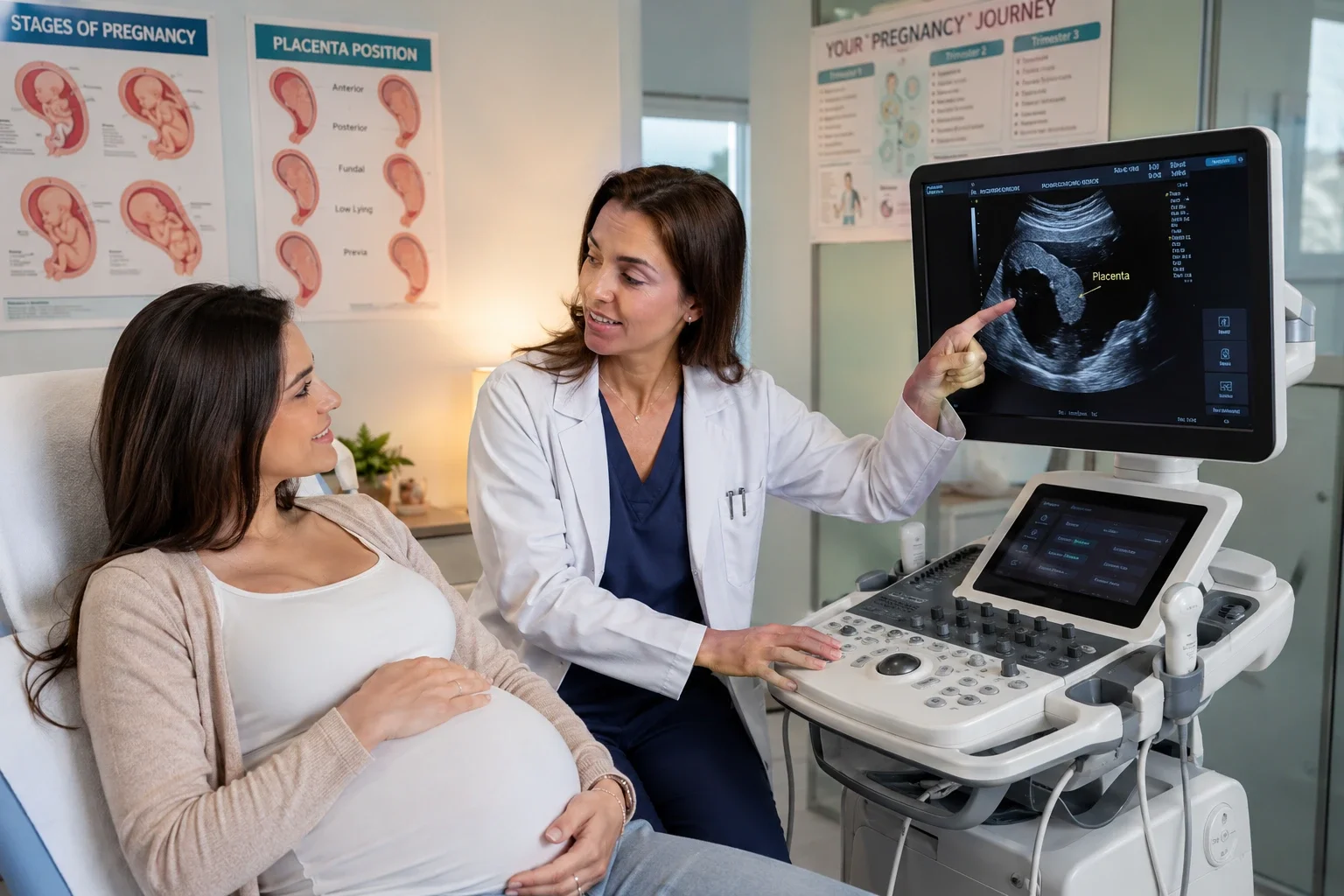
Placenta previa can sound frightening when you first hear those words, but understanding what it actually means is the first step toward feeling informed, prepared, and in control of your pregnancy journey.
Let's break it down together.
Watch Dr. Monique explain placenta previa:
What Is Placenta Previa?
Placenta previa is a condition that occurs when the placenta attaches low in the uterus and covers, either partially or completely, the opening of the cervix. That opening is called the cervical os, and it's the passage your baby needs to move through during delivery.
The placenta is a remarkable organ. It develops inside the uterus during pregnancy and serves as your baby's lifeline, delivering oxygen and nutrients while removing waste, all through the umbilical cord. Normally, the placenta attaches to the top or side of the uterine wall. With placenta previa, it implants lower than ideal, which can create complications as pregnancy progresses.
Types of Placenta Previa
There are two main types that providers look at today:
Complete placenta previa means the placenta is fully covering the cervix. This type is less likely to resolve on its own and always requires a C-section delivery.
Marginal placenta previa means the edge of the placenta is within two centimeters of the cervical opening but not fully covering it. This type is more likely to shift into a safer position as pregnancy continues.
How Common Is It — And Here's the Reassuring Part
Up to 6% of pregnancies show signs of placenta previa during the second trimester ultrasound. That number might feel alarming, but here's what's important to know: in the vast majority of cases, the situation resolves on its own before delivery.
As your uterus grows and expands, the placenta effectively shifts upward. It doesn't actually move, but the relative position changes as your uterus stretches. By the time of delivery, fewer than 1% of women still have placenta previa. So if you've just been told you have it at your 20-week scan, that is not a reason to panic. It's a reason to stay informed and keep attending your prenatal appointments.
When Is Placenta Previa Usually Found?
Most women find out they have placenta previa during their second trimester anatomy scan, typically done between 18 and 22 weeks of pregnancy. This is a routine ultrasound, and the finding is often unexpected.
In some cases, a woman may not have had an ultrasound but notices painless vaginal bleeding in the second or third trimester. Painless bleeding during pregnancy, especially in the second half, is one of the hallmark signs of placenta previa and should always be evaluated by your provider right away.
Symptoms to Watch For
The most common symptom of placenta previa is bright red vaginal bleeding, usually without pain, after 20 weeks of pregnancy. The bleeding can start and stop, returning a few days later. Some women also experience mild cramping or low back pain alongside the bleeding.
It's also possible to have placenta previa without any bleeding at all, which is why theat routine prenatal ultrasound is so valuable.
If you experience any vaginal bleeding during pregnancy, contact your healthcare provider immediately. If the bleeding is heavy or accompanied by significant pain, go to the emergency room without waiting.
Why Does Bleeding Happen?
As pregnancy progresses into the third trimester, your cervix begins to thin and soften in preparation for labor. If the placenta is touching or covering the cervix, this natural process causes bleeding. When the cervix begins to dilate during labor, the blood vessels connecting the placenta to the uterus can tear which is another source of bleeding.
This is also why sexual intercourse, tampon use, and douching are not recommended during a placenta previa diagnosis. Anything that could disturb the cervix carries a risk of triggering bleeding.
How Is It Diagnosed?
Placenta previa is diagnosed through ultrasound. Your provider may use:
Abdominal ultrasound: The transducer is moved along the outside of your belly and provides a general view of the placenta's position.
Transvaginal ultrasound: A small wand is gently inserted into the vagina and gives a clearer, more precise look at how close the placenta is to the cervix. This is considered safe during pregnancy.
Your provider will likely recommend follow-up ultrasounds throughout the remainder of your pregnancy to monitor whether the placenta's position has shifted.
How Is Placenta Previa Managed?
Treatment depends on several factors: how much bleeding is occurring, how far along the pregnancy is, the exact position of the placenta, and the overall health of both mother and baby.
If placenta previa is found early and there's no bleeding:
Your provider may recommend pelvic rest (no sex, no tampons, no douching), reducing strenuous activity, and more frequent prenatal monitoring. Many cases resolve without any intervention.
For cases with moderate to severe bleeding:
Management may include bed rest, sometimes in the hospital, possibly medications to prevent preterm labor, and steroid injections to help your baby's lungs develop in case early delivery becomes necessary.
Delivery:
If the placenta continues to cover the cervix as you approach your due date, a scheduled C-section is the safest option for delivery. A vaginal delivery with placenta covering even part of the cervix carries too high a risk of hemorrhage. Between 32 and Around 36 weeks, your provider will begin planning the timing of delivery based on your specific situation.
The goal is always to get you as close to your due date as possible while keeping you and your baby safe.
Risk Factors for Placenta Previa
While there's no known single cause, certain factors increase the likelihood of developing placenta previa:
Being 35 or older, carrying multiples (twins or more), a history of C-section or other uterine surgeries, previous placenta previa, uterine fibroids, smoking, or cocaine use. If any of these apply to you, mention them to your provider so they can monitor you appropriately. including with your prenatal care visits and ultrasound schedule.
Possible Complications
For the majority of women, placenta previa, — especially when found early and monitored carefully, — does not lead to serious complications. However, it's important to know the risks so you can recognize warning signs:
For the mother, these can include heavy bleeding before or during delivery, early delivery, anemia from blood loss, and in more complex cases, a condition called placenta accreta (where the placenta grows too deeply into the uterine wall).
For the baby, the primary risk is premature birth if an early C-section becomes necessary, which can come with challenges like low birth weight or underdeveloped lungs.
Questions to Ask Your Provider
Knowledge is power — and having the right questions ready for your next appointment can help you feel confident and in control. Here are a few to bring up:
How much of my cervix is currently covered?
What should I watch for at home that would mean I need to call you or go to the ER?
Should I be modifying any of my activities?
When will we do the next ultrasound to check the position?
If the placenta hasn't moved by 36 weeks, what does my delivery plan look like?
If you're navigating this diagnosis and want guidance from providers who take the time to listen and educate, our prenatal care team at Enrich Health is here for you. Our group prenatal visits also create space for you to ask these questions in a supportive community of other expectant mothers.
A Final Note: You Don't Have to Face This Alone
A placenta previa diagnosis can feel isolating and scary. IBut in most cases, with proper monitoring and care, you and your baby can have a healthy outcome. The most important things you can do are stay informed, attend all your prenatal appointments, and speak up about any symptoms you experience, especially any vaginal bleeding.
At Enrich Health, we believe that knowledge reduces fear. The more you understand what's happening in your body, the more empowered you are to make informed decisions about your care.
Have questions about your pregnancy or want to schedule a prenatal visit with our team in Hamden or Bridgeport, CT?
Call us at (203) 200-0417 or contact us here.
Sources & Further Reading
This article was written by the clinical team at Enrich Health and reviewed for medical accuracy. For additional information on placenta previa, we recommend the following trusted resources:
American College of Obstetricians and Gynecologists (ACOG) — Bleeding During Pregnancy
MedlinePlus, U.S. National Library of Medicine — Placenta Previa
Medically reviewed by Dr. Andrea Lee, Certified Ob-Gyn
